

Intent
Our art and design technology (DT) curriculum is designed to balance knowledge, skills, experiences and opportunities to apply learning in a variety of interconnected contexts. The curriculum is underpinned by the school’s values and ethos.
The learning in art and DT is guided by the Kapow scheme of learning. Teachers follow the school’s curriculum map and medium term plans accordingly, using the areas of learning Kapow provides as a teaching resource and for teacher’s professional development. The different areas of learning have been linked to the school’s skills, which are coherent throughout school and through other subjects. Children develop a range of skills throughout their lessons and this progression continues throughout school.
Medium-term plans are clear and with explicit age-related expectations (ARE) for each year group. They are carefully structured based upon NC objectives, knowledge and the inclusion of skills to ensure end goals are clear and that progression is measurable from Reception to Year 6.
Access to the art and DT curriculum is adapted to suit the needs of the children, given the context of the school. Children’s learning in EYFS and KS1 has a strong focus on early acquisition of language, phonics and reading, yet this is primarily done through quality first teaching in an inclusive way. Throughout school, children work in mixed-ability groups, learning from a variety of models. Teaching vocabulary is a priority in school and links directly to the school’s context. Vocabulary is an important part of our school development plan. English is a second language for the majority of our children, which means that we need to expose them to a wider range of vocabulary and develop their understanding.
The art and DT curriculum is widely encouraged throughout other subjects as an effective way to develop children’s understanding and further demonstrate their artistic skills. The Creative History approach to learning is an inclusive, holistic approach that enables children to choose their own artistic medium to demonstrate their understanding. Whilst art skills are not explicitly taught during these lessons, they provide different practical experiences that enable all children to independently showcase their knowledge of different art forms.
Each class has an artist which they study throughout the year during whole school WOW events. This gives the children a wider understanding of artists, artistic paradigms, the history of art and the range of art forms. By the end of the children’s school experience, they will have learned about 7 artists thoroughly and been provided with the opportunity to demonstrate their knowledge multiple times throughout each year.
Cultural capital is a priority within the school. School has a personalised list of ’11 things to do before 11’ which include various visits and experiences to enhance later life. (Nursery –picnic in the park and making mud pies, Reception – visit to the farm and bug hunting, year 1- visit to the zoo, year 2- visit to the seaside, year 3 – build a den, year 4- theatre experience, year 5 – star gazing, year 6 –adventurous activity day.) All children have access to extra-curricular clubs, with priority being given to disadvantaged pupils. Cultural capital is furthered by the inclusion of the life skills curriculum, which allows for activities that provide real-life experiences. (CRE8 – art/DT skills; forest schools – outdoor learning; cookery – DT cooking and nutrition.) Throughout each of their years at Clarendon, every child will access all areas of life skills.
We are a Rights Respecting school and follow the United Nations Convention on the Rights of the Child (UNCRC). This convention is a universally agreed set of non-negotiable standards and obligations, built on varied legal systems and cultural traditions. These basic standards also known as human rights, set minimum entitlements and freedoms that are respected and put into effect by governments. The 42 articles on the rights of the child are founded on respect for the dignity and worth of every individual regardless of ethnicity, gender, language, religion, opinions, origins, wealth, ability or any other status, and therefore, apply to every human being everywhere.
Implementation
The art and DT curriculum is designed to allow all children to make good progress from their starting points. All year groups teach the practical, theoretical and disciplinary knowledge and skills with clear progression linked to the national curriculum. In each key stage, we focus on helping children understand that events can be interpreted in different ways, providing opportunities for purposeful discussions and the development of reasoning skills, alongside the development of the children’s understanding of how art and DT link to real-life contexts. There is a progression of both knowledge and skills, which is clearly evidenced in children’s books.
Art includes the teaching of practical making skills, knowledge of artists, evaluating and analysing art, generating ideas and using sketchbooks. These are taught through the following areas of learning:
Design technology includes the teaching of designing, making, evaluating and technical knowledge. These are taught through the following areas of learning:
The curriculum team work alongside teachers to embed high-quality teaching and learning in all classes. These high standards within the quality of education are ensured through:
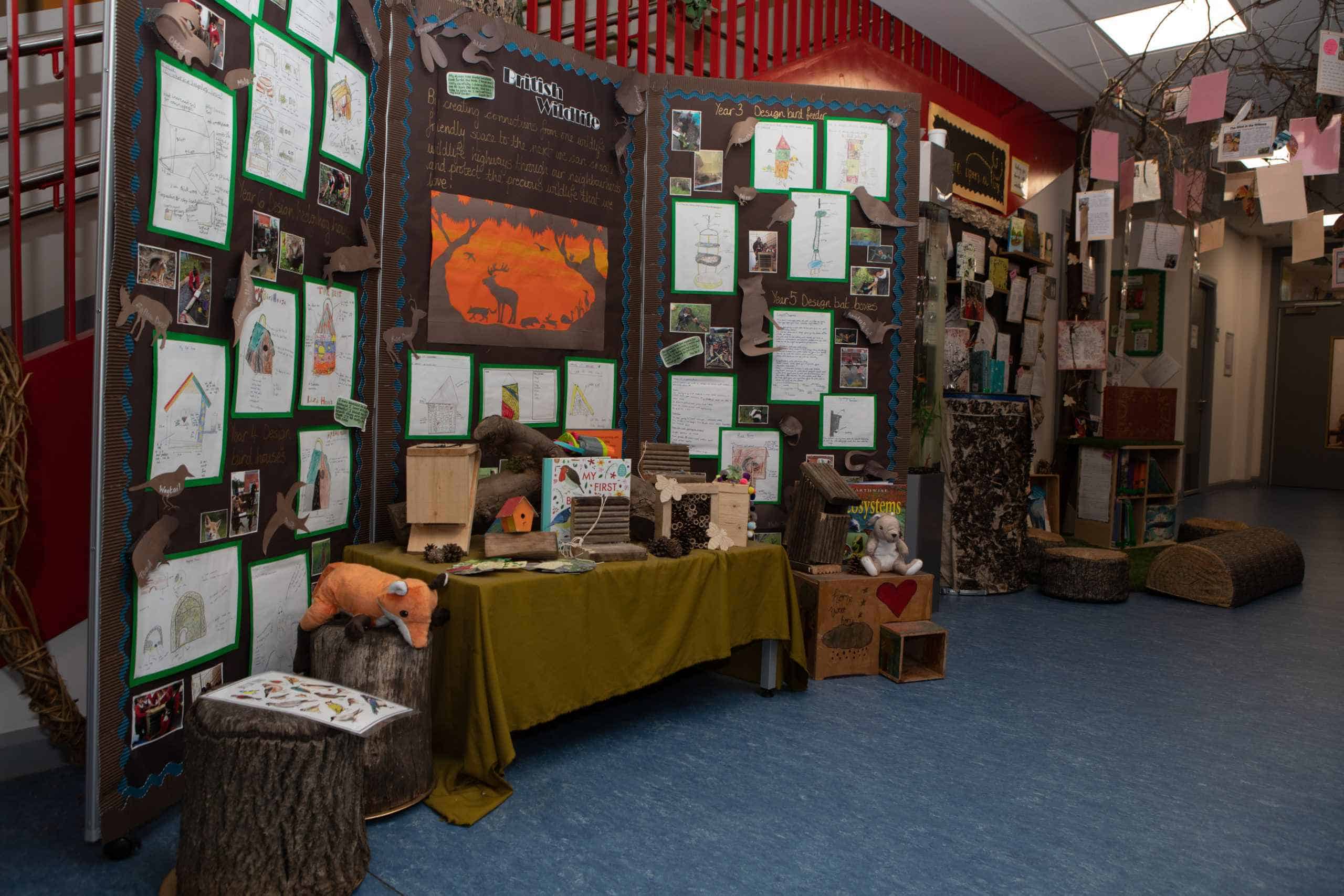
Cultural Capital: Teachers use cultural capital opportunities such as visits, visitors and cross-curricular learning opportunities to stimulate and embed art/DT skills. Teachers often use outside facilities to enhance the learning experience for all children. This includes a stage area, outdoor classrooms, allotment, pond and large tables. Our life skills activities enhance the children’s learning and bring the topics to life. Activities include cookery, den building, Forest Schools, fire pit experience, use of tools, and creating products.
Monitoring and Evaluation: Subject monitoring is triangulated, including evidence in books, quality and effectiveness of teaching, pupil voice, progression over time and planning. Subject leaders also support colleagues through peer coaching in the teaching of art and DT, being informed about current developments in the subject, and providing a strategic lead and direction for the subject in the school. Learning walks take place to identify, through first-hand evidence, the quality of teaching in lessons and the generation of purposeful learning environments with high-quality resources. Children will be invited to discuss their learning as part of a pupil voice exercise. This checks children are retaining knowledge alongside acquiring skills to apply in cross-curricular contexts.
Assessment: We assess children’s work by making informal judgements as we observe them during each lesson. On completion of a piece of work, the teacher marks the work and asks a follow-up question to deepen understanding. Where appropriate, these challenge questions will focus on making links and comparisons to embed the children’s knowledge and understanding. Every child has targets in front of their books showing coverage and skills that will be achieved by the end of the year. Teachers will highlight as they are achieved. At the end of a unit of work, teachers complete an assessment tracker by highlighting targets that have been taught during the half-term. They identify the children as being emerging, developing or secure within the year groups, using # to show the depth of understanding.
CPD: Teachers are supported throughout the year as part of monitoring, inset days and peer coaching. Monitoring and data analysis highlight gaps and areas where teachers need support. This is then discussed with the teacher in a supportive manner and steps for progress are agreed. Whole school Curriculum Day allows subject leaders to celebrate as well as to share expectations and goals, including training opportunities and all necessary resources for the next academic year. External training is also offered to all staff, including subject leadership for members of the curriculum team.
Impact
The impact of high-quality teaching in art and DT is clear, as assessment shows evidence of progression in knowledge and skills learned by the children. The curriculum offers a breadth of experiences and Cultural Capital.
The monitoring of impact in art and DT incorporates many approaches. These include: